
Free-standing pillar jib cranes
Floor-mounted steel pillars with 180° or 360° slewing. Ideal where there is no suitable wall or overhead structure to mount against. Foundations sized to the duty and footprint.
UK manufactured
Pillar-mounted, wall-mounted, column-mounted and articulated jib cranes, engineered in the UK for capacities from 60 kg to 10 tonnes, with manual or powered slewing.
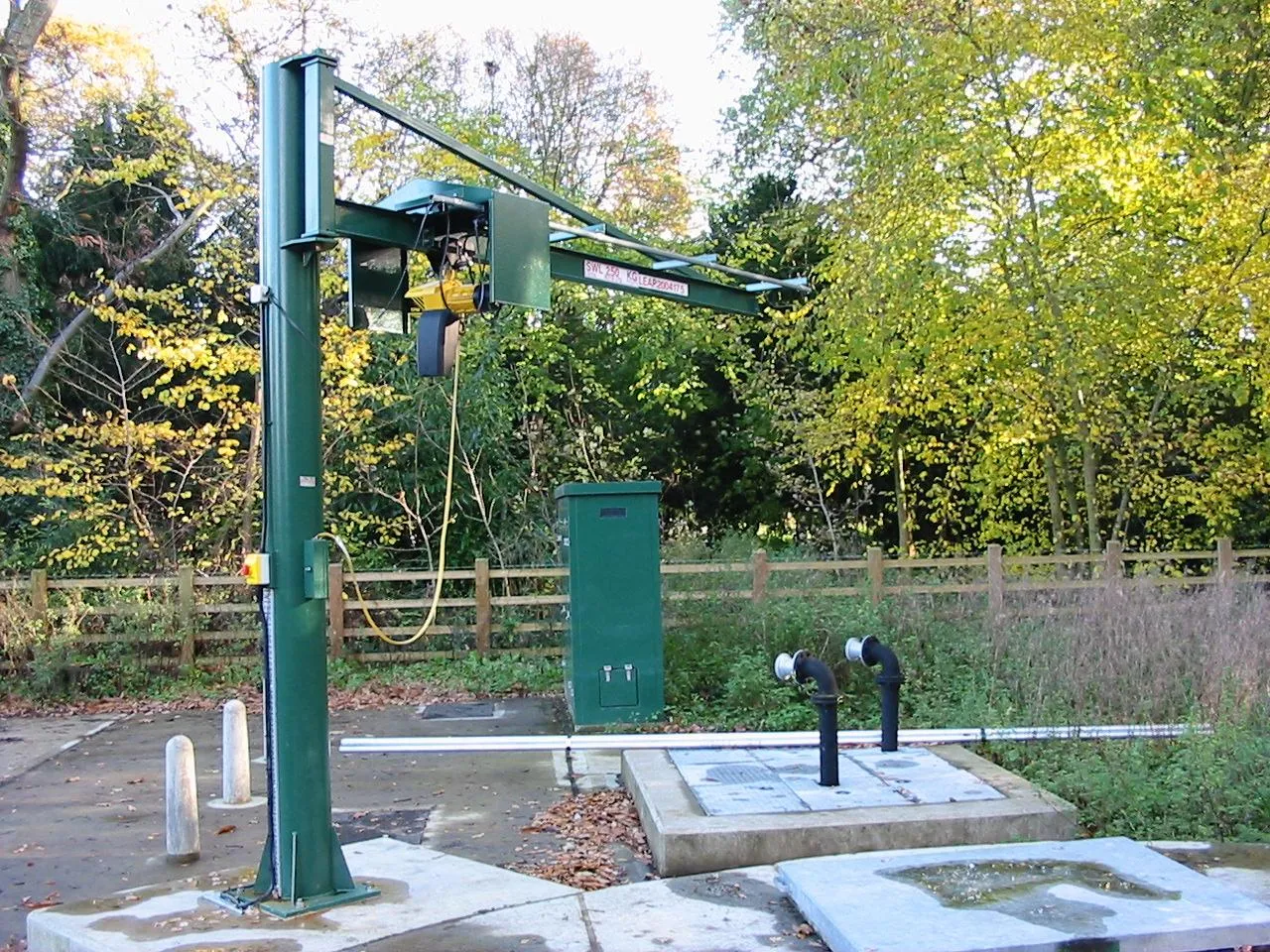
Jib cranes are the workhorse lifting device of the engineering workshop — the piece of equipment that sits over a workstation, a bogie bay, a press, or a machining centre and handles everything from a 60 kg sub-assembly to a 10 tonne fabrication. Somers Handling designs and manufactures jib cranes in the UK to BS EN 13001, supplying steel mills, rail depots, aerospace fabrication halls, civil nuclear facilities, and construction-industry workshops up and down the country.
Wherever a repetitive lifting task needs to happen at a fixed point — a welding bay, a paint booth entry, a machine-tool loading station, an assembly jig, a test rig — a jib crane is usually the most economical and most ergonomic choice. The operator works within a swept quadrant or a full circle rather than having to walk the load across a bay. For high-cycle workstations that translates directly into shorter cycle times, fewer manual handling risks, and measurably lower accident rates compared with slings and forklifts.
Typical deployments we see at Somers:
BS EN 13001 is the harmonised standard for bridge and gantry cranes, and the framework we design jib cranes against for the UK and European market. The structural calculation covers the hoist motion duty, slewing motion duty, wind load (where relevant), and the foundation or host-structure reactions. For cast-in or bolted base plates we size the anchor group and issue a foundation drawing with the required concrete grade and reinforcement detail. For wall- and column-mounted variants we supply the host-structure reaction loads so the customer’s civil or structural engineer can confirm adequacy.
Every Somers jib is proof-load tested in-house at 125% of SWL before shipping, under LOLER 1998, and supplied with a thorough examination certificate at commissioning. Ongoing statutory inspection — 6-monthly for man-riding or accessory-rated use, 12-monthly for goods-only — is available as a service.
The quickest way to a usable jib-crane specification is a short conversation about what you’re actually lifting. Load weight and shape, operating environment, duty cycle, available headroom, and any host-structure constraints are enough for our engineers to scope the right variant and propose an SWL / outreach / slewing combination. From there we can either confirm against a nearest-standard Somers model or produce a bespoke design — both come back with CAD, calculations and a fixed price.
Jib cranes are supplied in the following common configurations. Bespoke variants are engineered to order.
Floor-mounted steel pillars with 180° or 360° slewing. Ideal where there is no suitable wall or overhead structure to mount against. Foundations sized to the duty and footprint.
Bolt or weld-on jibs that use existing building structure for support. Lower installed cost than free-standing, with up to 180° slewing across a workstation or machine cell.
Two-section boom with an articulated joint that allows the hook to reach around obstructions, into machine envelopes, or along narrow bays.
Standard capabilities below — higher capacities, longer spans and non-standard finishes available on request.
| Safe working load (SWL) | 60 kg – 10 t Higher capacities on request. |
|---|---|
| Jib outreach | 1 m – 12 m |
| Slewing angle | 180° or 360° Manual push, geared or powered. |
| Height under hook | Engineered to workstation |
| Hoist options | Manual chain block, electric chain, electric wire rope |
| Standards | BS EN 13001, LOLER CE / UKCA marked; supplied with test certification. |
Industries
Send a short description of your load, environment and duty — a Somers engineer will respond within one working day.