
PUWER 1998 explained — provision and use of work equipment
The Provision and Use of Work Equipment Regulations 1998 set the UK framework for making sure any work equipment — including lifting equipment — is safe to use, suitable for the job and maintained properly.
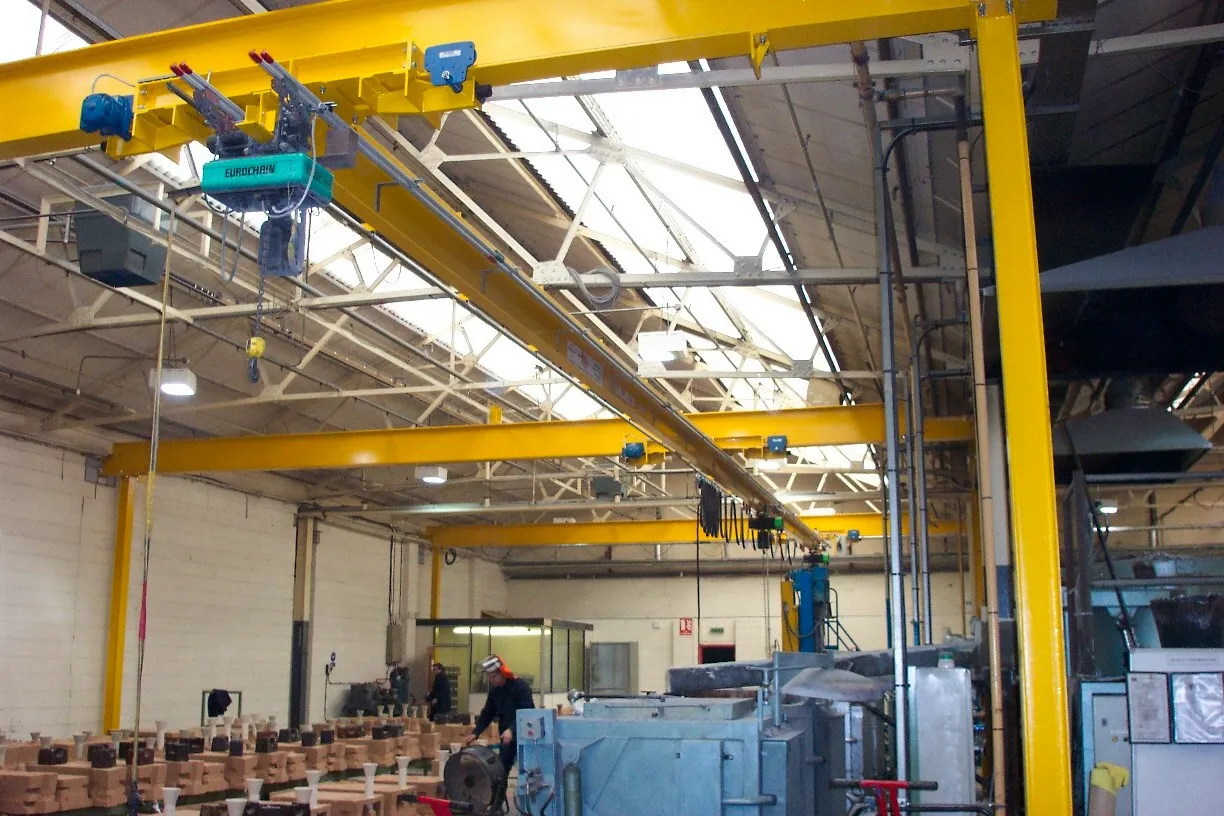
The Provision and Use of Work Equipment Regulations 1998 — PUWER — is the broader UK regulation governing any piece of equipment used at work. Lifting equipment, machine tools, forklifts, compressors, pneumatic presses, vehicle lifts, welding sets — all of them fall under PUWER. If LOLER is the specific statute for lifting operations, PUWER is the general one that sits behind it.
Scope
PUWER applies to any “work equipment” — which the regulation defines broadly as any machinery, appliance, apparatus, tool or installation for use at work. That covers almost all lifting equipment, including:
- Overhead cranes, jib cranes, gantries, monorails.
- Rail vehicle lifting jacks, vehicle lifts and scissor lifts.
- Tongs, grabs, spreader beams, lifting frames and other lifting accessories.
- Hoists, chain blocks, winches and ratchet devices.
- Any custom lifting aid designed for a specific task.
Lifting equipment therefore sits under both PUWER and LOLER. LOLER layers lifting-specific requirements (thorough examination intervals, marking of SWL, lift planning) on top of the broader PUWER framework.
The core PUWER duties
- Suitability. Work equipment must be suitable for its intended use. A lifting device has to match the load and the environment — hot slab tongs for hot-line duty, not cold-line tongs with uprated paint.
- Safety. Equipment must be maintained in a safe condition. This is the duty that drives planned preventive maintenance schedules.
- Inspection. Equipment must be inspected where its safety depends on installation conditions or where it’s exposed to conditions causing deterioration. Records of inspection must be kept.
- Competence. Work equipment must only be used by people who have received adequate information, instruction and training.
- Dangerous parts and controls. Physical guarding, emergency stops, clearly-marked controls, isolation facilities — all specified by PUWER.
- Stability. Work equipment must be stabilised to prevent it from shifting or falling under load.
- Lighting, markings and warnings. Adequate lighting for safe use; clear markings on controls; visible warnings where a residual risk remains.
PUWER vs LOLER — which applies?
Where both apply (which is almost every lifting scenario), the duty-holder’s approach is straightforward:
- Design and selection: Equipment is suitable (PUWER) and strong enough (LOLER).
- Installation: Equipment is positioned safely (both PUWER and LOLER) — but LOLER adds specific stability requirements under load.
- In use: Lift operations are planned and supervised (LOLER), operated by trained people (PUWER), and inspected on a regular cycle under PUWER plus thorough examination under LOLER.
- Maintenance: Kept in safe condition (PUWER) with records; LOLER adds the statutory thorough-examination report requirement.
In practice, the PUWER inspection regime and the LOLER thorough-examination regime are usually delivered together as a single service.
What duty-holders should actually do
- Put lifting equipment on a planned inspection and maintenance schedule — don’t wait for breakdowns.
- Keep written records of inspections and maintenance — PUWER expects them and LOLER requires them for thorough examinations.
- Make sure operators are trained and authorised — including for equipment that looks simple.
- When buying new equipment, confirm the supplier’s documentation pack covers both PUWER suitability (declaration of conformity, operating manual, risk assessment) and LOLER strength (proof-load test, declaration of conformity to BS EN 13155 or equivalent).
In short
PUWER is the general regulation that every piece of work equipment in the UK falls under; LOLER adds lifting-specific duties on top. A duty-holder compliant under LOLER for lifting operations will usually also be compliant under PUWER — but not automatically: PUWER covers broader concerns like operator training and equipment suitability that LOLER doesn’t touch.
Somers Handling designs and manufactures lifting equipment to meet the UK regulatory framework end-to-end, and offers LOLER thorough examinations and PUWER-compliant maintenance programmes as ongoing services.
Tags
- PUWER
- Regulation
- Compliance
Related equipment
Jib cranes
Pillar, wall-mounted and articulated jib cranes, UK-manufactured from 60 kg up to 10 tonnes, manual or powered slewing.
View productCranes, gantries and monorails
Overhead cranes, portable gantries and monorail systems engineered to your span, duty and working environment.
View productRail vehicle lifting
Rail vehicle lifting jacks, bogie rotators and depot equipment for depot maintenance and rolling-stock OEMs.
View product