
Retrofit vs replace — when to modernise an overhead crane
A practical decision guide for facilities managers and engineering teams weighing up the economics of refurbishing an older crane versus replacing it outright.
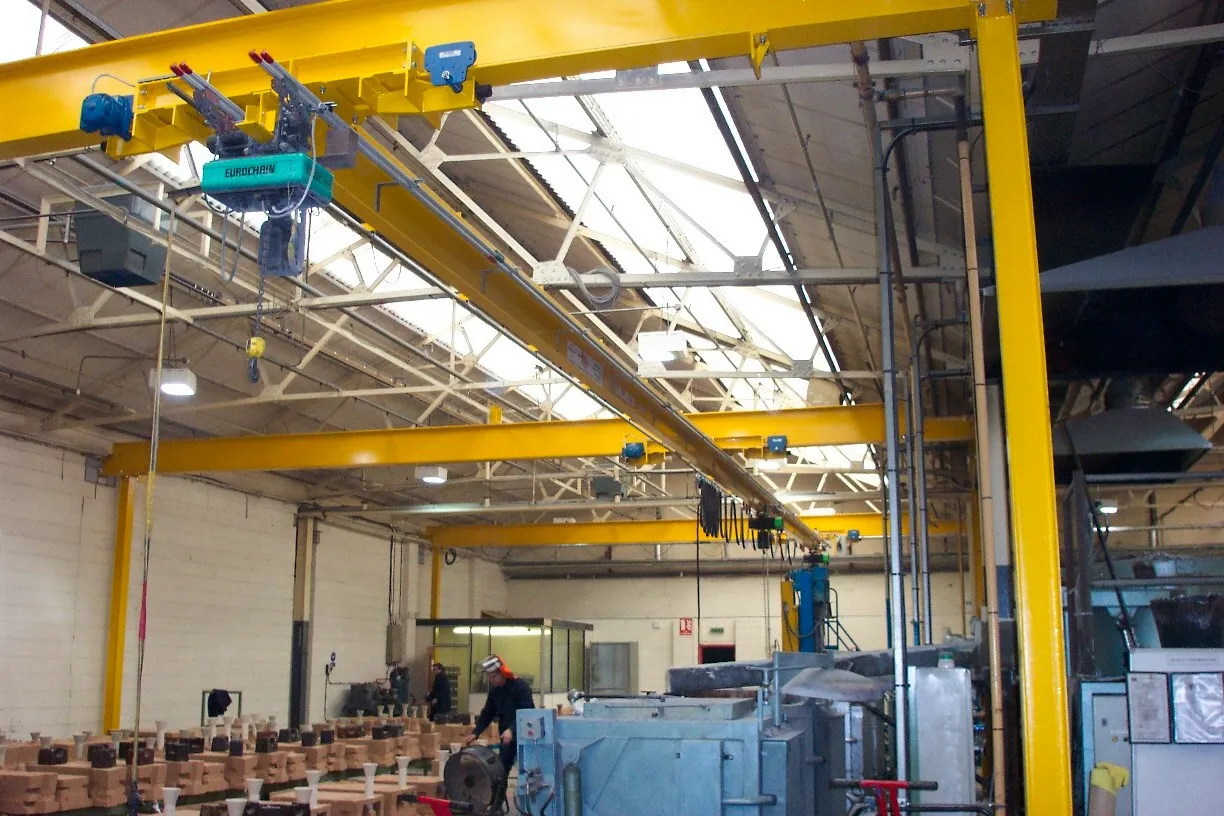
Overhead cranes are long-life assets. A well-built crane will outlive the process it was originally specified for — often twice over. That longevity creates a recurring commercial question across UK industry: at what point is it no longer worth refurbishing the existing crane, and is it time to replace it outright?
What can usually be refurbished
The structural steel itself is almost always refurbishable if it’s in sound condition. Girders, end carriages, crab frames — if the steel is structurally OK, it’s a candidate for a full refurbishment programme covering:
- Paint system renewal — shot-blast and recoat. Typically a 10–15 year interval.
- Control system modernisation — relay logic to PLC, new pendant or radio remote, variable-speed drives. This is often the single highest-value upgrade.
- Brake and limit refresh — brakes and limit switches are wear items with a finite life, and modern equivalents are usually fit-for-purpose upgrades.
- Hoist replacement — the hoist is often the failure-mode hotspot and is frequently replaceable within the existing crane geometry.
Red flags that push towards replacement
A few indicators typically change the calculus:
- Cracked or fatigued structural members — repair is possible but rarely commercially sensible at full replacement cost.
- Obsolete safety systems that can’t be retrofitted — some older designs simply don’t accept modern limiters, overload protection or anti-collision systems without wholesale structural modification.
- Capacity-change requirement — an uprate from, say, 5 t to 10 t usually pushes the original design beyond its safe envelope. Replace.
- Substantial structural corrosion — surface rust is repairable; pitted or section-loss corrosion on load-bearing members often isn’t.
- Incomplete or missing design documentation — refurbishment is much more expensive when the original calculations don’t exist and have to be redone from first principles.
The commercial reality
The right answer depends as much on the site’s capital-planning cycle as it does on the crane’s condition. A 40-year-old crane that’s still structurally sound and has decent documentation can often be refurbished for 30–40% of replacement cost, and come out with another 15–20 years of service life. A similarly-aged crane with structural issues and no paperwork is usually better replaced.
In short
Neither refurbishment nor replacement is universally “right”. A condition survey with a written engineering report — including a fixed-price quote for each option — is the minimum due diligence before a decision. The cost of that survey is typically recovered many times over in avoiding the wrong call.
Tags
- Maintenance
- Overhead cranes
- Modernisation