
Adjustable aircraft lifting beam — 35 tonne SWL, under five tonnes self-weight
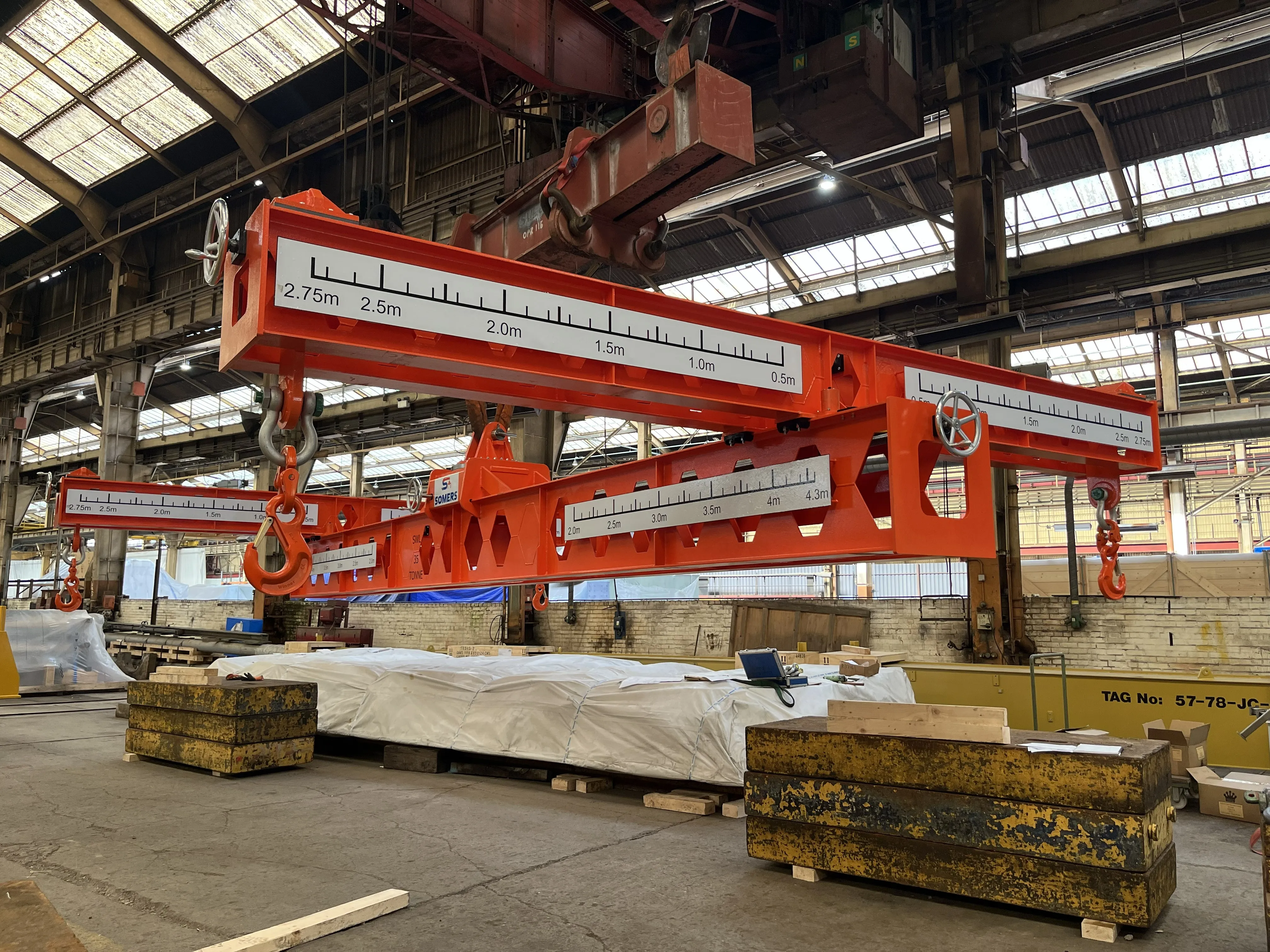
Purpose-designed adjustable lifting beam for suspending a complete aircraft inside an anechoic chamber, engineered to maintain the aircraft's centre of gravity directly below the suspension point regardless of load configuration — and weighing under five tonnes despite a 35-tonne safe working load.
Client: Confidential — aerospace sector
Challenge
The beam was designed to suspend a complete aircraft inside an anechoic chamber — a specialist test environment engineered to absorb acoustic or electromagnetic energy, used to characterise an aircraft's signature under controlled conditions. In this context, precise orientation of the aircraft is not simply a handling preference; it is a test requirement. Any departure from a level, stable attitude would invalidate the test data, making the accuracy of the suspension system as critical as its structural capacity. Unlike most industrial loads, an aircraft's geometry means that the positions at which the load can be attached vary depending on type and configuration. As those hanging points move, the distribution of load across the beam changes, and with it the combined centre of gravity. Left uncorrected, any offset between the centre of gravity and the suspension point would cause the aircraft to hang at an angle — an outcome incompatible with the precision the test environment demands. A further constraint made the challenge significantly more demanding: the complete beam assembly was required to weigh less than five tonnes. The anechoic chamber's structural load limits, combined with the need to minimise any mass that could influence the acoustic environment, meant that self-weight was as tightly controlled a parameter as the SWL itself.
Engineering response
Somers Handling's engineers began with the fundamental constraint: the suspension point must always sit directly above the combined centre of gravity of the aircraft and the beam together, regardless of how the load is distributed across the lifting attachments. The solution is an adjustable beam whose geometry can be configured to suit each specific lift. As the positions of the aircraft's hanging points are established, the beam is set accordingly, moving the effective suspension point to compensate for the changing load distribution and ensuring the aircraft hangs level throughout the lift. Achieving a self-weight below five tonnes while maintaining structural integrity at 35 tonnes SWL required a rigorous approach to material selection and structural optimisation. High-strength steel was specified throughout, with every section of the beam designed to carry only what the load case demanded — a structure significantly lighter than a conventionally designed beam of equivalent capacity.
Outcome
The beam was designed, manufactured and delivered to specification, meeting the 35-tonne SWL requirement and the sub-five-tonne weight limit. It is now in use suspending aircraft inside the client's anechoic chamber, providing the level, stable orientation the test programme requires. Its adjustable configuration means it is capable of accommodating multiple aircraft types from a single piece of equipment — extending the operational life of the investment across future test programmes.
Anechoic chamber testing places lifting equipment under a different kind of scrutiny from conventional handling. The load still needs to be supported safely, but the suspension system also becomes part of the test environment — its mass, its geometry, and the orientation it imparts to the aircraft all affect what the test records.
The engineering problem
A beam that allows the aircraft to hang off-level, or that brings unnecessary mass into the chamber, compromises the test before it begins. The challenge Somers Handling solved here had two distinct and equally demanding parts:
- Maintain precise CoG alignment across a wide range of hanging point positions — so the aircraft hangs truly level regardless of load configuration.
- Keep the complete assembly under five tonnes at a 35-tonne safe working load — a ratio that demands design from first principles, not adaptation of standard equipment.
Engineering highlights
- 35-tonne safe working load, designed and manufactured to current standards.
- Adjustable geometry to maintain the aircraft’s centre of gravity directly below the suspension point across all load configurations.
- Designed to accommodate varying imposed loads as hanging point positions shift between lift configurations.
- Complete beam assembly weighing under five tonnes — a significant structural challenge at this safe working load.
- High-strength steel construction, fully optimised to meet weight and strength requirements simultaneously.
- Bespoke design from first principles, with no reliance on adapted standard equipment.
- Designed for deployment inside an anechoic chamber, where suspension accuracy and self-weight are test-critical parameters.
In service
The beam is now in use suspending aircraft inside the client’s anechoic chamber, providing the level, stable orientation the test programme requires. Its adjustable configuration means it can accommodate multiple aircraft types from a single piece of equipment — extending the operational life of the investment across future test programmes.
Similar challenge on your site?
Send a short description of the load, environment and duty — a Somers engineer will be in touch within one working day.